 CasinOntario
Your Ontario Casino Night Can Cost What You Planned
October 23, 2026
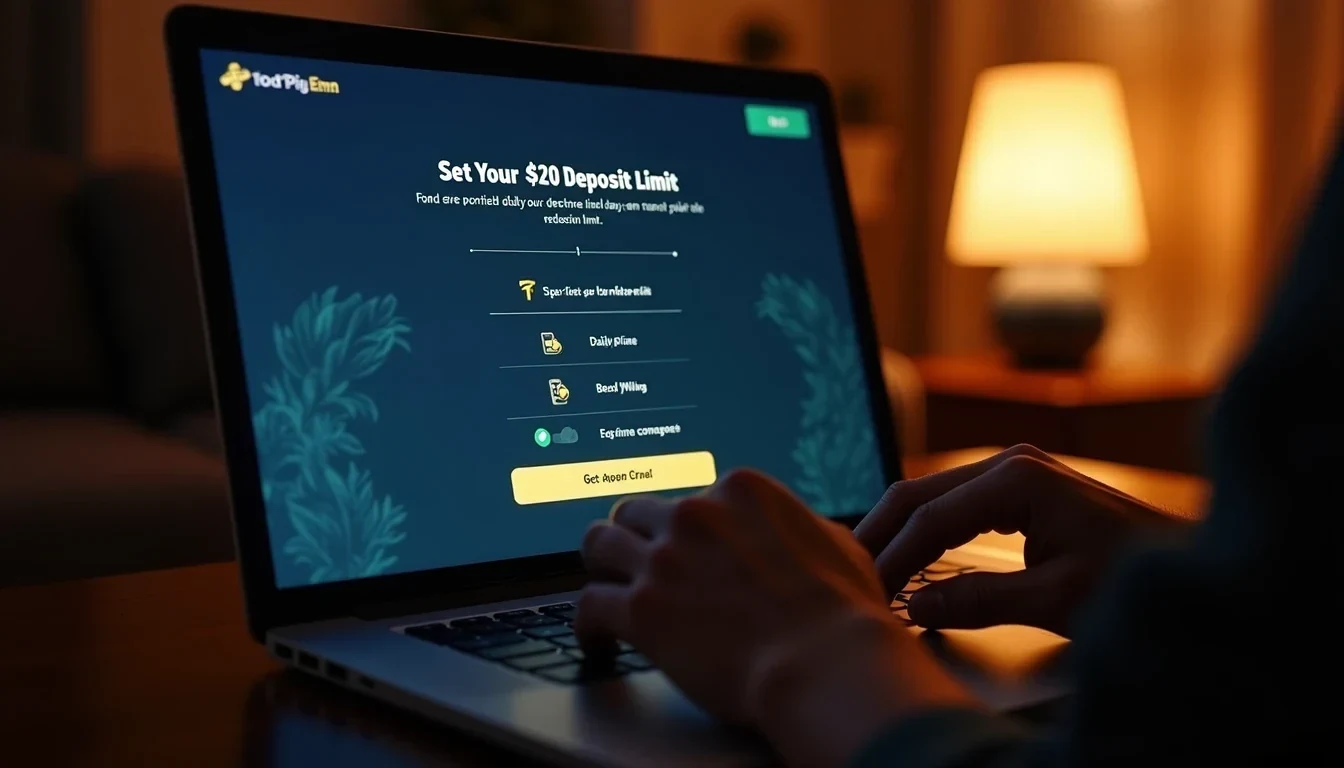
A $20 bill buys you two hours at the movies or a hundred spins on a slot machine. The theatre will not hand you back forty dollars halfway through the film, then quietly convince you to stay for another show. Online casinos will. The number you decide before you log in matters more than any strategy you learn after.
Ontario’s regulated market gives players tools most jurisdictions do not mandate. The Alcohol and Gaming Commission of Ontario (AGCO) requires every licensed operator to build deposit limits, loss limits, and session timers directly into their platforms. iGaming Ontario, which manages the province’s market, audits these features. They are not buried in submenus; they are front and centre. The regulator treats your predetermined limit as a binding contract, not a gentle suggestion. This article shows how to make that contract work at three common price points, and why the amount you settle on before you play should never depend on whether you are up or down.
Why Your Budget Is a Ticket Price, Not a Seed Fund
The first mistake is semantic. Call it a “bankroll” and you have already framed casino play as an investment with an expected return. Call it an entertainment budget and the psychology shifts. This money is allocated the same way you would allocate funds for a concert or a Leafs game. You do not purchase a ticket expecting to resell it for profit. You purchase it for the experience, and the cost is final before the event begins.
Ontario’s framework reinforces this framing at the regulatory level. Licensed sites must present responsible gambling tools during account setup and at deposit. Deposit limits can be set daily, weekly, or monthly. Loss limits cap net losses within a period. Session time limits log you out automatically. These are not loyalty programme perks. They are legal requirements because the AGCO’s mandate centres on harm prevention, not operator convenience.
The practical implication is simple. Your entertainment budget should come from disposable income only. Rent, groceries, debt payments, and savings contributions happen first. What remains is the pool from which you draw leisure funds. If losing the entire amount would alter any non-discretionary plan, you are playing with money that was never yours to risk.
What $20 Actually Buys You
At minimum bets common across Ontario-licensed slots, $0.20 per spin is standard. A $20 budget therefore purchases exactly one hundred spins. At six hundred spins per hour on a typical online slot, that is ten minutes of continuous play if you never win. Of course you will win sometimes. The point is the ceiling. You have purchased a finite number of decisions, and each spin consumes one.
Virtual blackjack operates differently. Minimum hands often run $0.50 to $1.00 on Ontario sites. At $1 per hand, your $20 covers twenty hands. Blackjack plays slower, roughly fifty hands per hour, so the same budget stretches forty minutes even without wins. The trade-off is direct: fewer decisions per dollar, but each decision involves more player input and less pure chance.
The $20 session tests discipline. A small win, say $8 on a bonus round, can feel like a reason to increase your stake. It is not. Your original $20 was the entertainment cost. Any return is a discount, not a signal to upgrade your ticket.
What $50 Changes
Double the budget and the arithmetic opens up. Two hundred and fifty spins at $0.20, or fifty hands at $1 blackjack. The $50 player can also choose to vary stake size within the session, something the $20 budget rarely permits. You might open at $0.40 spins, accept faster depletion for higher potential payouts, then drop to $0.20 if your balance falls below $30.
This flexibility introduces a decision point that smaller budgets avoid. More options mean more opportunities to deviate from your plan. The disciplined $50 player decides the structure in advance. Will you split the budget into two $25 sessions? Will you set a floor, cashing out if you drop below $25, regardless of time elapsed? These rules must be settled before the first spin, because mid-session you will want to reinterpret them.
Ontario’s loss limits are particularly useful here. Set a $25 loss limit for the day and the platform enforces your floor automatically. You cannot override it in the moment without a cooling-off period. This regulatory infrastructure works in your favour, removing the willpower test entirely.
What $100 Permits, and What It Risks
Five hundred spins at $0.20. One hundred blackjack hands at $1. The $100 budget enters territory where players often confuse duration with value. More money does not mean you should play faster or higher. It means you have purchased a longer experience, and the same principles apply at larger scale.
The specific risk at $100 is the win-reinvestment trap. Hit a $40 bonus round early and your balance reads $140. The disciplined response is to withdraw the $40 immediately, returning to your original $100 limit. The tempting response is to view the $40 as house money and increase your stake to $0.50 or $1 per spin. This is how predetermined budgets dissolve. The $40 was never house money. It was your money the moment it hit your balance, and it should leave your account the same way.
Session time limits become more valuable at this level. A $100 budget can sustain two hours of play easily. Two hours is long enough for fatigue to impair judgment. Set a ninety-minute timer. When it expires, the session ends, regardless of your current balance. The AGCO-mandated tools are designed for exactly this scenario.
The Tools That Enforce What Willpower Cannot
Ontario players have access to several mechanisms that turn intention into architecture. Deposit limits cap how much you can move into your casino account within a set period. Loss limits cap net losses. Session timers cap duration. These three, used together, remove the need for continuous self-denial.
My PlayBreak offers a more aggressive option. The province-wide self-exclusion programme blocks access to all regulated Ontario gambling sites for a period you choose, from one day to indefinite. It is not a punishment. It is a recognition that some players need external enforcement, and the regulated market provides it without stigma.
Withdrawal speed also matters for budget discipline. Ontario-licensed sites process Interac withdrawals within one to three business days typically. The delay is friction, and friction is useful. A player who must wait forty-eight hours to access winnings is less likely to reinvest them impulsively than one with instant access.
The Core Rule That Survives Every Budget Level
Your predetermined spending limit applies whether you are winning or losing. This sentence separates planned entertainment from reactive gambling. A losing session does not justify a top-up. The budget was the cost of admission, and the show ended when the funds depleted. A winning session does not justify increased stakes. The budget was the cost of admission, and a discount does not mean you buy a better seat.
The house edge in online casino games is a mathematical certainty over time. No budget size, no staking strategy, no “hot” machine alters this. Slots carry return-to-player rates typically between 92% and 96%, meaning the expected value of every dollar wagered is $0.92 to $0.96. Blackjack with basic strategy can approach 99.5%, but basic strategy is exacting and rarely executed perfectly under time pressure. These numbers are not secrets. They are published on every Ontario-licensed site. They mean that winning is always possible in a single session, never guaranteed across sessions.
Where to Apply This
If you are ready to test these principles with a regulated Ontario operator, BetNova offers the full suite of AGCO-mandated tools. Deposit limits, loss limits, session timers, and Interac withdrawals are all available at account level. The platform is licensed by iGaming Ontario, meaning your predetermined budget is backed by provincial oversight, not merely operator policy. Set your limit before you fund your account, and let the infrastructure do the rest.
If gambling is affecting your life beyond your entertainment budget, ConnexOntario provides confidential support at 1-866-531-2600.